Dr. ERIK
GESLIN
I am a researcher and practitioner whose work has evolved from the study of human emotions and cognition in interactive media toward a broader non‑anthropocentric and ecocentric philosophy of media design aimed at transforming social imaginaries and challenging the current destructive paradigm.
In the first phase of my career, I focused on engineering psychology, affective gaming, and the neuroscience of emotion in video games and virtual reality, developing methods for inducing emotions through parameters such as color, brightness, movement speed, spatial layout, and social interaction volume in virtual environments.
I contributed to the design of emotional color scripting based on circumplex models of emotion and worked on emotionally reactive systems such as “Bernardo Autonomous Emotional Agents” and empathy‑oriented VR platforms using avatars and physiological measures to modulate users’ emotional states and presence. This work, carried out across academia and the video game industry, positioned me as a specialist in the induction and measurement of human emotion in XR and game contexts.
Building on this foundation, my research trajectory has shifted from a primarily human‑centered perspective to a conceptualization of media that recognizes the intrinsic value of all living beings and the importance of biodiversity, without lapsing into misanthropy. I explicitly frame this as a move from studying human emotions through cognition and neuroscience to developing a non‑anthropocentric, biocentric, and ecocentric philosophy that re‑situates humanity as one component of the living world, neither superior nor negligible but ontologically equal. In this context, I mobilize ecolinguistics and critical discourse approaches to interrogate how media narratives and mechanics encode anthropocentric assumptions, and to design alternative media forms that decenter the human and foreground more‑than‑human agencies.
In parallel, I have extended this critique of anthropocentrism into the field of astrobiology and SETI by proposing an exopsychological, biocentric contact‑willingness factor within the Drake Equation. Rather than asking only how many extraterrestrial civilizations might exist, my work questions whether sufficiently advanced, ecologically mature civilizations would actually wish to communicate with a species that still exhibits strong tendencies toward conquest, excess, and ecological self‑destruction. The aim of this reframing is less to decide whether extraterrestrial life would be “interesting” for humans than to prompt an autocritical reflection on our own anthropocentrism and ecological immaturity, using the so‑called Great Silence as a mirror for our civilizational values.
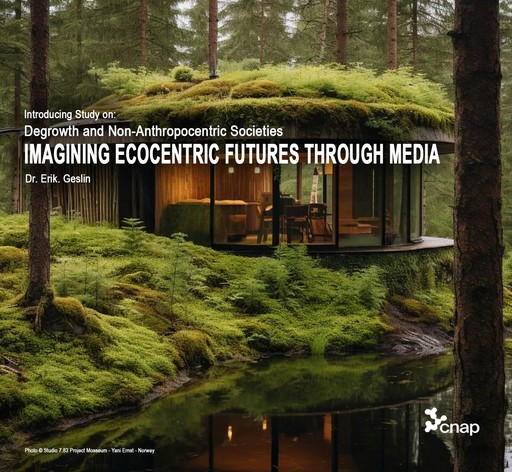
My recent work conceptualizes media—notably games, XR, and virtual environments—as vectors capable of reshaping social imaginaries, particularly for younger generations, by presenting ecocentric futures and non‑anthropocentric value hierarchies. I have contributed to the development of instruments such as the Non‑Anthropocentric Media Evaluation Questionnaire (NAMEQ) and related biocentric evaluation tools to assess how media portray non‑anthropocentric societies and degrowth‑oriented imaginaries, thereby operationalizing the critique of dominant extractivist paradigms within empirical media studies. Through these tools and concepts, my research seeks to move beyond mere representation of ecological themes toward media designs that actively participate in the reconfiguration of collective desires, norms, and aspirations away from human exceptionalism and toward ecocentric coexistence, both on Earth and in how we imagine potential others beyond it.
about.
I am exploring how media can help shape new social imaginaries grounded in biocentric perspectives.